Shaky Cam, Full Heart: Why Your Kid's Terrible Soccer Video Is a Time Capsule Worth Keeping
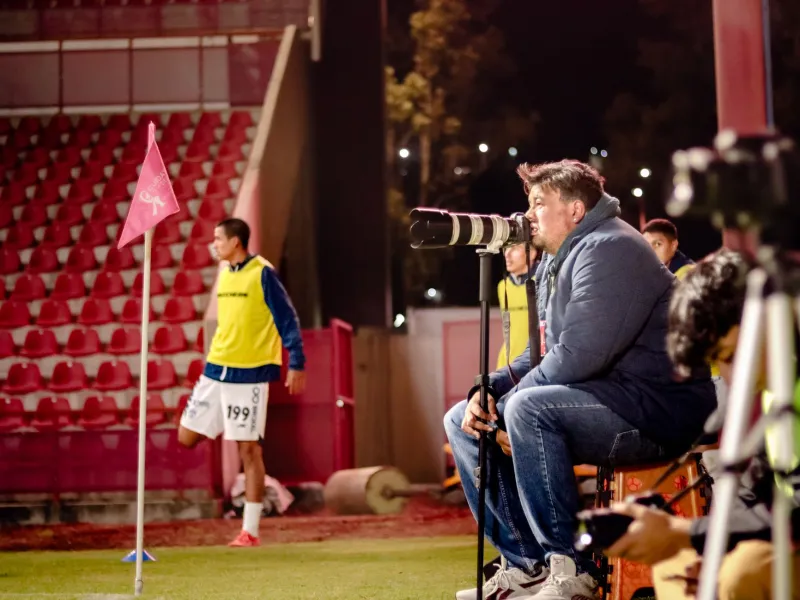
Let's be honest. You know the video. You filmed it with one hand while holding a lukewarm coffee in the other. The camera drifts halfway through. Someone's dad walks directly in front of the lens right when your kid finally gets close to the ball. There's wind noise. There's always wind noise. And then — the moment you were building toward — your kid trips, the ball rolls wide, and you can hear yourself muttering something under your breath before the clip cuts off.
You probably watched it once and thought about deleting it.
Don't.
Because here's the thing nobody tells you when you're standing on the sidelines of a U10 recreational soccer game on a Saturday morning in October: that video is the real thing. Not a version of real life. Not a representation of it. The actual, unfiltered, muddy-cleated thing.
What Polished Content Can't Do
We live in an era of extraordinary visual production. Your Instagram feed is full of golden-hour portraits and carefully soundtracked Reels. TikTok serves up content that's been lit, scripted, and edited by teenagers who understand framing better than most film students from twenty years ago. Even the "candid" stuff is usually curated within an inch of its life.
None of that is going to tell future generations how we actually lived.
Think about what historians use to understand the past. Sure, they look at official records and formal portraits — but the stuff that really illuminates everyday life tends to be the informal material. Old letters. Grocery lists. Photographs of people who didn't know the camera was pointed at them. The documentary record that wasn't trying to be documentary at all.
Your kid's bad soccer game video is exactly that kind of material.
The Data Hidden in the Mundane
Pull up that clip and really look at it — not at your kid, but at everything else.
Look at the other parents. What are they wearing? Probably some combination of branded athletic gear, hoodies from local schools, maybe a team jacket with a name ironed on the back. Look at the cars in the parking lot behind the field. Look at the portable canopy someone set up with a folding table underneath it and a Yeti cooler and a bag of those little orange slices that every youth sports team in America has been eating since approximately 1987.
Listen to the background noise. Other kids playing on adjacent fields. A referee's whistle. Someone calling out instructions in a mix of English and Spanish. A notification sound from somebody's phone. The particular ambient texture of American suburban community life, recorded without any intention of recording it.
That's the stuff that vanishes. That's the stuff that, fifty years from now, people will want desperately to see and mostly won't be able to find — because most of it got deleted to free up storage space.
What 2024 Actually Looks Like From the Sidelines
If you wanted to explain American childhood and parenting culture in 2024 to someone who had no frame of reference, you could write a thousand academic papers. Or you could show them about four minutes of typical youth sports sideline footage and get 80% of the way there in a fraction of the time.
They'd see the way parents engage with their phones even while cheering. They'd see the demographic mix of a typical American suburb in real time. They'd see the particular anxiety that lives in how adults talk to kids about performance — the careful calibration between encouragement and expectation that defines a whole parenting philosophy without anyone ever naming it out loud.
They'd see the snack rotation. They'd see the team huddle. They'd see the coach — probably a volunteer dad with a clipboard and a whistle he ordered from Amazon — trying to remember everyone's name while also managing seventeen different personalities and one kid who just wants to look for roly-polies near the corner flag.
This is sociology. This is anthropology. And it's sitting in your camera roll right now, probably buried somewhere between a screenshot of a recipe you never made and a photo of a parking sign you took because you weren't sure if you were allowed to park there.
The Accidental Archivist
Here's a reframe that might change how you think about all of this: you are, whether you signed up for it or not, an archivist.
Every time you pull out your phone at a school event or a backyard birthday party or a Tuesday night dinner where nothing particularly interesting is happening, you are making a decision about what gets preserved. Most of the time you're not thinking about it in those terms. You're just trying to catch a moment. But the cumulative effect of all those small decisions is a record — imperfect, personal, and irreplaceable.
The guerrilla approach to filmmaking has always been about capturing life as it actually is, not as you wish it looked. No budget, no crew, no controlled lighting. Just a camera and whatever's happening in front of you. That instinct — the one that makes you hit record even when the conditions aren't right — turns out to be historically valuable in ways that none of us fully appreciate in the moment.
Why "Bad" Footage Is Often the Best Footage
The shaky camera work isn't a flaw. It's evidence that you were there, that you were human, that you were juggling seventeen things at once the way American parents in 2024 are always juggling seventeen things at once.
The wind noise is a timestamp. The awkward silences between plays are data. The moment where you accidentally film the ground for fifteen seconds while you fish a snack out of your bag — that's real life. That's the texture of it.
Professional sports footage will survive. Highlight reels will survive. But the lived experience of a random Saturday morning in October, at a public park somewhere in middle America, where a bunch of seven-year-olds are nominally playing soccer while mostly just running in approximate circles — that only survives if you keep the video.
Keep the Outtakes
You don't have to do anything elaborate here. You don't need to organize everything into a carefully labeled digital archive or invest in external hard drives (though backing things up is genuinely a good idea). You just need to resist the reflex to delete the stuff that doesn't look good.
The missed goals. The sideline chaos. The kid who wandered off to examine something on the ground while the game was happening twelve feet away. Keep it. All of it.
Because someday — and this is the part that will sneak up on you — that kid is going to be older, and the world is going to look different, and you're going to want to remember exactly what a Saturday morning felt like when the biggest thing on the agenda was a recreational soccer game and a bag of orange slices.
And if you're lucky, you'll have the video. Wind noise and all.