Pressed Play After Twenty Years: What Your Old Home Videos Are Actually Telling You
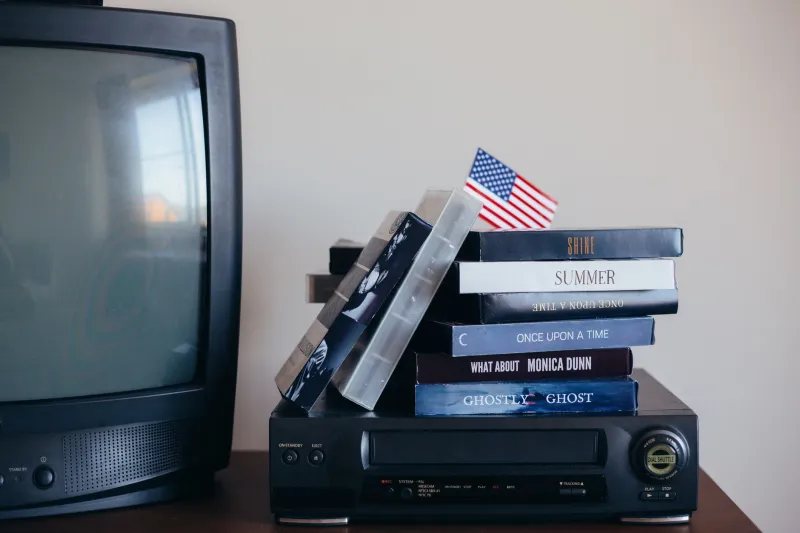
Somebody digs out a box of old tapes. Maybe it's a rainy weekend, maybe a parent passed away and left behind a collection nobody knew what to do with. The camcorder footage loads up — grainy, a little washed out, the audio slightly warped — and suddenly everyone in the room goes quiet. Not because something dramatic is happening on screen. Because nothing dramatic is happening. It's just a Tuesday afternoon in 1998, and that's somehow the most disorienting thing imaginable.
That's the strange power sitting inside your old home videos. They're not trying to tell you anything. Nobody was performing for history. And that's exactly what makes them so honest.
The Stuff Nobody Meant to Record
Here's the thing about home video: the camera was almost always running a few seconds too long, or pointed slightly in the wrong direction. You aimed at the kid blowing out birthday candles, but you also caught the kitchen behind them — the avocado-green appliances, the paper towel holder shaped like a rooster, the refrigerator covered in coupons held up by novelty magnets.
Nobody archived that refrigerator on purpose. Nobody thought, someday this will matter. But scroll through footage from the early '90s and you'll find a thousand little details that tell you more about how Americans actually lived than any museum exhibit could. The snack foods on the counter. The brand of soda in the two-liter on the table. The television visible through the doorway, playing something you can almost but not quite make out.
Anthropologists call this kind of material "unintentional documentation." The rest of us just call it Tuesday.
Fashion as a Timeline
Clothing might be the most obvious giveaway, but it's still startling when you see it. Watch a video from 1995 and the silhouettes alone are enough to place it within a two-year window. Oversized flannel. Tapered jeans. A particular shade of purple that showed up everywhere for about eighteen months and then vanished completely.
But go deeper than the obvious stuff. Look at the kids. Look at what a seven-year-old is wearing in 1994 versus 2004 versus 2014. The shift from denim overalls to cargo shorts to slim-fit joggers tracks something real about how childhood itself got repackaged and resold every decade. Parents watching their own kids' old tapes often notice this with a kind of low-grade shock — not just we dressed differently but we thought about childhood differently.
The same goes for hair. Not just styles, but what those styles meant. A mom's haircut in 1988 home video carries an entire set of social signals that don't translate cleanly across thirty-five years. She wasn't just wearing her hair that way because she liked it. She was wearing it that way because of who she was, where she lived, what she was trying to say about herself in a very specific American moment.
Listen to How People Talked
Mute the music, turn up the ambient sound, and just listen to people talk in old home videos. This is where things get genuinely fascinating.
The slang shifts are obvious — words that were everywhere in 1997 that nobody has said unironically since 2003. But the more interesting changes are subtler. The way adults spoke to children. The way men and women talked to each other at family gatherings. What got laughed at. What got glossed over. What nobody thought to comment on because it was just... normal.
Watch a video from a family Christmas in 1989 and pay attention to what the adults say when they don't think anyone's really listening. The offhand comments. The jokes that land differently now. The things that were said out loud, casually, in front of children, that would stop a room cold today. None of it was malicious — most of it was just unremarkable in its moment. That's the point. The tape preserves not just what was said, but what was acceptable to say. And that's a genuinely useful record of how social norms shift over decades.
Technology in the Background
Every old home video is also an accidental technology museum. The brick-sized cordless phone sitting on the counter. The desktop computer visible through the office doorway with its enormous CRT monitor. The VCR with the clock that was always blinking 12:00. The stereo system taking up an entire wall of the living room.
What's striking isn't just that the technology was different. It's how central it was — physically, spatially. A family's relationship to their television set in 1985 looked completely different than it does now. The TV was furniture. It was the piece of furniture. Rooms were arranged around it. And then slowly, without anyone making a formal announcement, that changed. Watch enough home video across enough decades and you can almost track the exact year a particular family's living room stopped being organized around the television and started being organized around... nothing in particular, because everyone had a screen in their pocket.
Family Dynamics You Forgot You Had
This might be the most personal layer, and the one that tends to hit hardest. Old home videos don't just show you how your family looked. They show you how your family worked.
Who held the camera, and who performed for it. Who stayed off to the side. Which parent ran the show at holidays and which one disappeared into the kitchen. The sibling dynamics that got smoothed over in memory but are right there on tape, unambiguous. The grandparent who was the gravitational center of every gathering, and the footage from the first Christmas after they were gone, where everyone is clearly trying to figure out how to be a family without that anchor.
None of this was scripted. Nobody sat down and said, let's document our family power structure for future analysis. But the camera caught it anyway, because cameras are honest in ways that memory isn't.
Why This Matters Beyond Nostalgia
It's easy to dismiss old home videos as pure sentiment — something you watch once when you find them, get a little teary-eyed, and put back in the box. But there's a real argument that this footage is something more than that.
Collectively, millions of hours of American home video represent an unfiltered, ground-level record of how ordinary life actually changed across the second half of the twentieth century and into the twenty-first. Not the history that got written down. Not the version that made it onto the news. The version that happened in kitchens and backyards and school gymnasiums and living rooms, recorded by people who were just trying to hang onto something before it slipped away.
The irony is that by not trying to make something important, they made something irreplaceable.
So if you've got tapes sitting in a closet somewhere, or a hard drive full of old phone videos you haven't opened in years — it might be worth pressing play. Not just to remember. But to actually look. Because what's in those recordings isn't just your past. It's a pretty detailed record of all of us, caught on camera when nobody was paying attention.