The Most Important Home Movies You'll Ever Make Are the Boring Ones
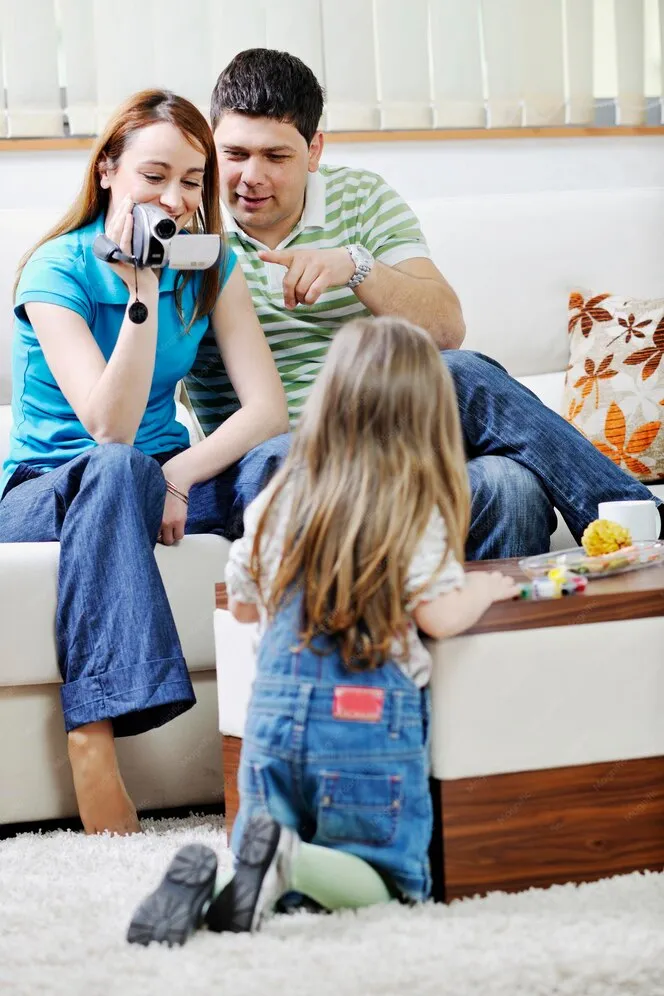
Photo: family candid home video recording child birthday living room, via img.freepik.com
The Footage Nobody Plans to Shoot
Ask any parent what they'd grab in a house fire — after the people and the pets — and you'll hear the same answer over and over: photos and videos. Not the expensive furniture. Not the jewelry. The memories.
And yet most of us are wildly inconsistent about creating those memories on purpose. We pull out the phone for birthdays and holidays and the first day of school. We mostly forget to record the stuff in between — the Tuesday afternoon when your six-year-old spent forty-five minutes explaining an elaborate fantasy world she'd invented, the way your son laughed at something on TV when he was eight, the specific cadence of your daughter's voice before it changed.
That in-between stuff? That's the footage that wrecks people. In the best possible way.
What We Actually Miss When We Watch Old Home Video
There's a psychology to why home video hits so differently than photographs. A still image freezes a moment in space. Video captures it in time — the movement, the sound, the way a person exists in the world rather than just in a frame.
Dr. Clay Routledge, a behavioral scientist who has written extensively on nostalgia, describes home video as one of the most potent triggers for what researchers call "social connectedness nostalgia" — the specific emotional experience of feeling reconnected to people and versions of yourself that no longer exist in the present.
In plain terms: when you watch a video of your kid at age four, you don't just see them. You hear their little-kid voice. You watch the way they move. You remember exactly what that kitchen smelled like and what that afternoon felt like. The video is a portal, not just a record.
That's why families who discover long-lost home footage — old VHS tapes converted to digital, camcorder recordings found in a closet — so often describe the experience as emotionally overwhelming. Not because the content is dramatic. Usually it's the opposite.
Lisa Okafor, a mother of three in suburban Atlanta, found a box of MiniDV tapes from 2003 to 2008 while cleaning out her late mother's garage. "There was this one tape," she told us, "that was just Christmas morning. Nobody was doing anything special. My mom was making coffee in the background. My dad was complaining about the news. I hadn't heard my dad's voice in six years." She paused. "I watched it four times that day."
The coffee-making. The complaining about the news. That's the stuff.
Birthday Videos Are Just the Beginning
Birthday parties are easy to document because they're events. There's a built-in reason to pull out the camera. But here's the problem with only recording events: events are performative. Kids know a camera is out. They make faces. They do bits. They become a version of themselves that's performing for the lens.
The real gold is the unscripted stuff. And capturing that requires a slightly different approach than waiting for the cake to come out.
A few things worth trying:
The drive-around recording. Kids talk in cars. Something about not having to make eye contact loosens them up. Set your phone in a cup holder (not while driving — passenger does this) and just let it run while you drive to practice or the grocery store. You'll capture conversations you'd never think to recreate.
The Sunday morning slow-roll. Pick one Sunday morning every couple of months and just... document the morning. Not staged. Not announced. Just the cereal bowls, the cartoons, the dog begging, the arguments about screen time. Fifteen minutes of footage. You'll be stunned what that becomes in twenty years.
The "what are you doing right now" interview. Casually walk up to your kid while they're playing and ask them to explain what they're doing. No setup, no performance. Just genuine curiosity. Kids at play are the most themselves they'll ever be, and the explanations they give are often hilarious, profound, and deeply specific to who they are at that age.
The end-of-year sit-down. Once a year — New Year's Eve works well, or the last day of school — sit down with your kids individually and ask them the same set of questions. What was your favorite thing this year? What was hard? What do you want to do next year? What's your favorite food right now? Keep the questions consistent across years. Watching those interviews side by side, year after year, becomes something extraordinary.
On the Technical Stuff (Which Matters Less Than You Think)
You do not need a fancy camera. Seriously. The best camera for family documentation is the one you actually use, and for most people that's a smartphone. Modern phone cameras shoot in 4K and capture remarkably clean audio in quiet indoor environments.
A few things that do matter:
- Horizontal video. Always. Shoot horizontal unless you're specifically posting to a vertical-format platform. Your future self watching this on a TV will thank you.
- Light is everything. Natural window light is your best friend. Overhead fluorescent light makes everyone look vaguely ill. If you're inside, get near a window.
- Let scenes breathe. Don't cut every two seconds. Hold on faces. Hold on hands. Hold on the mess on the kitchen counter. The mundane details are the historical record.
- Label everything. When you transfer footage, name the files with dates and basic descriptions. "Video_001" tells you nothing in fifteen years. "2024_June_Maya_soccer_game" tells you everything.
The Backup Question Nobody Wants to Deal With
Here's the uncomfortable truth: footage that only lives on your phone is footage you could lose tomorrow. Phones get stolen, dropped in pools, and wiped during software updates gone wrong.
A simple three-step backup system works for most families: auto-upload everything to iCloud or Google Photos, keep a copy on an external hard drive that you update quarterly, and once a year burn a DVD or upload a highlight reel to a private YouTube or Vimeo account. It sounds like overkill until the day it isn't.
The Real Reason This Matters
Here's the thing about home video that doesn't get said enough: it's not really for you. Or, it's not only for you. The footage you shoot of your kids at seven and nine and twelve is eventually going to be watched by people who aren't born yet. Your grandchildren, maybe. Your great-grandchildren, almost certainly, if the files survive.
Think about what you would give to watch ten minutes of your great-grandmother just existing in her kitchen. Making dinner. Laughing at something. Being a person.
You have the ability to give that to someone who doesn't exist yet. That's not a small thing. That's an act of love across time.
So yeah — film the birthday. Film the cake and the candles and the whole chaotic mess of it. But also film the Tuesday. Film the boring drive. Film the dog sleeping in the afternoon light and your kid explaining something nobody asked about.
That's the footage that matters. That's the stuff that lasts.